

♪ The future of Store Checks: trends and developments 2026 and beyond
Published on 15. July 2026 | Updated on 15. July 2026
Reading time: 16 minutes
The way store checks are carried out is in a fundamental change. Technological innovations, changed consumer expectations and new business models transform the Filial Audit. In this article we take a look at the most important trends that will shape the future of Store Checks, and give you recommendations on how to prepare for it.
The driving forces of change
Several factors drive the transformation of Store Checks. Understanding these drivers helps to classify and strategically plan future developments.
Technical progress
AI, Computer Vision and IoT enable new forms of data collection and analysis that were unthinkable a few years ago.
Changed expectations
Real-time information and data-driven decisions become standard. Weekly reports are no longer enough.
Omnichannel reality
The fusion of online and offline requires new approaches for the detection and integration of POS data.
Sustainability
ESG criteria gain importance and are increasingly taken into account at Store Checks.
Trend 1: Autonomous and continuous data acquisition
The future belongs to the continuous automated data collection. Instead of spot visits by human testers, technologies such as IoT sensors, cameras and robots will enable permanent monitoring of the POS.
Technologies for autonomous detection
Smart Shelves: Record real-time inventory changes with integrated sensors
Ceiling cameras: Permanent video surveillance with AI analysis of the shelf situation
Autonomous robots: Self-propelled units scan racks regularly
RFID: Automatic collection of product movements
These technologies will not completely replace human testers, but will change their role. The focus shifts from data acquisition to interpretation, problem solution and relationship management with trade.
Trend 2: Predictive and Prescriptive Analytics
The analysis of Store Check data develops from descriptive (what happened?) to diagnostic (why did it happen?) to predictive (what will happen?) and prescriptive (what should we do?).
Analytics level Question Example
Descriptive What happened? | OOS rate was 5% |
Diagnostic Why did it happen? | Product X |
Predictive What will happen? | OOS risk for product Y in 3 days |
Prescriptive What should we do? | Increase order, activate second placement |
AI algorithms will be able to make predictions based on historical data and external factors and to generate concrete recommendations for action. This allows proactive rather than reactive action.
Trend 3: Integration and Networking
Store Check data is increasingly integrated with other data sources to get a holistic picture. The silos between different systems and departments are broken up.
Data integration of the future
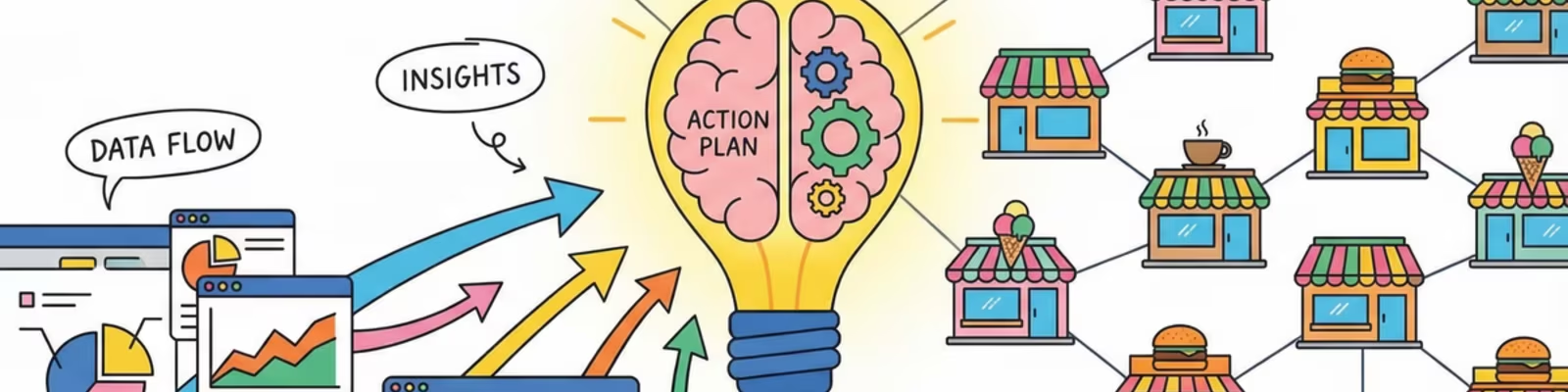
Imagine: Store Check data is combined in real time with POS sales, online traffic, weather data and social media sentiment. AI systems detect patterns and relationships that would be invisible to people and automatically generate recommendations for action.
Trend 4: Sustainability and ESG
Sustainability becomes a key topic at Store Checks. Companies are increasingly integrating aspects such as packaging waste, energy consumption and ethical procurement into their store reviews.
New test points for sustainability
Share of sustainable packaging on the shelf
Availability of organic and fair trade products
Energy efficiency of cooling furniture
Food waste and waste management
Communication of sustainability initiatives at POS
Trend 5: Personalization and Localization
The future belongs to hyperlocal optimization. Instead of uniform standards for all sales outlets, Store Checks will increasingly take into account the specific circumstances and customer needs of individual locations.
AI systems will be able to generate individual recommendations for each location: optimal range, ideal placement, location-specific promotions. Store Checks will validate these recommendations and monitor implementation.
Timeline: The Evolution of Store Checks
2024-2025 Wide adoption of mobile apps and cloud platforms. First AI-based image recognition is market-ready.
2026-2027 AI image recognition becomes standard. Predictive analytics allows proactive action. First autonomous robots in use.
2028-2030 Continuous, automated data collection in many sales outlets. Prescriptive Analytics automatically generates recommendations for action.
2030 + Fully integrated AI-controlled retail execution. Human testers focus on strategic tasks and relationship management.
How to prepare yourself
The future comes faster than thought. Companies preparing for the next changes will have a significant competitive advantage.
Recommendations for preparation
Create Digital Basics: If you don't work digitally yet, start switching to mobile apps and cloud platforms.
Improve data quality: AI systems are just as good as the data they are trained with. Invest in clean, structured data.
** Start pilot projects:** Experiment with new technologies such as image recognition in limited pilot projects.
** Build competencies:** School your team in data analysis and new technologies. The role of the examiner will change.
**Work with technology providers and trading partners to innovate together.
The role of man in the future
Despite all automation, people will play an important role in store checks in the future. However, the tasks will shift: away from the pure data collection, towards strategic and relationship-oriented activities.
** Future tasks of human examiner:** Interpretation of complex situations that AI cannot grasp. Relationship care with trading partners. Implementation of improvement measures. Training and coaching of trade workers. Creative problem solving with unusual challenges.
Frequently asked questions
Are store checks unnecessary by technology?
No, but they will change fundamentally. Data collection is increasingly automated, but the interpretation, action management and relationship management remain human tasks. The value of Store Checks will even increase as more and better data will be available.
How fast will these trends be?
The speed varies according to industry, region and enterprise size. Large companies and technology-affine industries will adopt faster. However, smaller companies will also benefit from cheaper, more accessible solutions in the medium term.
What are the biggest risks in non-adoption?
Companies that remain behind in digitization and automation risk competitive disadvantages due to slower knowledge, higher costs and poorer data quality. The gap to digitized competitors will increase over time.
Conclusion: Making the Future
The future of Store Checks is exciting and full of possibilities.Technological innovations will raise the efficiency and meaningfulness of branch examinations to a new level. At the same time, human skills such as interpretation, creativity and relationship management remain indispensable.
Companies that prepare for these changes at an early stage will be the winners of tomorrow. Start today to digitize your Store Check processes, invest in new technologies and prepare your team for the future. The transformation has already begun – be part of it.
Design the future with
Use the insights from this article series to make your Store Check strategy future-proof. The time to act is now.
Related articles

Matching primary solution
For a deeper feature and rollout context, start from Store check software.