
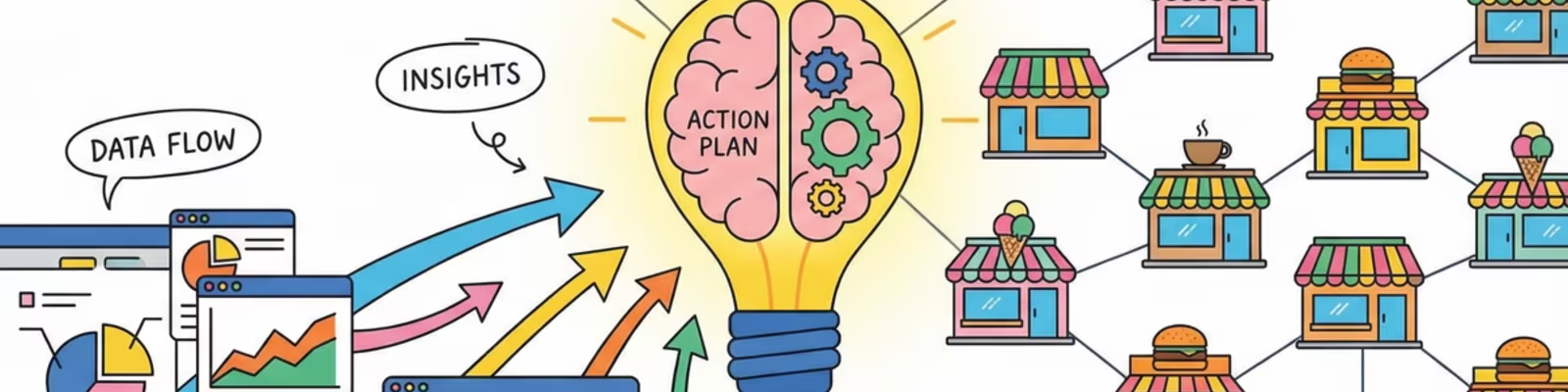
♪ The 7 most important features of a franchise CRM system: efficiency and growth for your network
Introduction: Why a specialized CRM is crucial for franchise companies
In the complex world of franchising, where coordination between franchisers and numerous franchises decides on success, efficient management is of central importance. While many companies rely on standard CRM systems (Customer Relationship Management) to manage their customer relationships, these solutions quickly reach their limits in the franchise model. A Franchise CRM is more than just a customer management software; it is the digital backbone that holds a whole network, standardizes processes and optimizes communication at all levels. But what exactly distinguishes a specialized CRM for franchise companies from a conventional solution, and what functions are indispensable to meet the specific requirements of this business model?
A standard CRM usually focuses on a single sales process and a uniform data structure. In franchising, however, there are two fundamentally different levels: the franchisor who wants to expand his network and win new partners, and the franchisees who run the end customer business on site. An effective Franchise CRM must be able to seamlessly image and connect both levels. The aim is to provide the franchisor with a comprehensive overview of the performance of the entire network, while franchisees receive the autonomy and tools they need for their local marketing and distribution. Without such a tailor-made solution, data silos, inefficient processes and an inconsistent brand experience for the end customer quickly arise – risks that no growing franchise system can afford.
The implementation of a specialized Franchise Management Software is therefore not a luxury, but a strategic necessity. It creates the technological basis for scalability, brand consistency and sustainable growth. In this article, we highlight the seven key features that characterize a modern Franchise CRM system and that significantly contribute to increasing efficiency and raising cooperation within your network to a new level.
The 7 key features in detail
A powerful franchise CRM system is characterized by a number of specific functions that are precisely tailored to the dual structure of the franchise business model. These tools enable efficient and transparent management of the complex relationships between franchisers, franchises and end customers. Below, the seven most important functions are presented in detail, which are essential for the success of each franchise network.
1. Central Lead Management and Tracking at Multiple Levels
The heart of each sales success is an effective lead management. In franchising, however, this process is unevenly more complex, as leads occur on two levels: potential new franchisees for the franchisor and potential end customers for the franchisees. A first-class Franchise CRM must be able to manage these two lead types separately but still connected. For the franchisor, this means being able to reproduce the entire process of franchise assignment – from the first contact to the conclusion of the contract – in a separate pipeline. At the same time, the system must be able to carry out national marketing campaigns and distribute the end customer leads generated therefrom automatically and according to predefined rules (e.g. geographical competence) to the correct franchisee.This automated assignment ensures that no request is lost and potential customers are contacted as soon as possible by the relevant partner on site. For the franchisor, the system offers its own local pipeline, in which it can manage and track the leads assigned to it as well as its self-generated contacts. Real-time tracking allows the franchisor to analyse the performance of the individual locations and to intervene in support of them if necessary without interfering in the partner's daily business. This transparency creates a win-win situation: The franchisor retains the overview and can make data-based decisions while the franchiseee benefits from qualified lead access and a professional tool for sales control.
2. Centralized email marketing and automation
The preservation of a consistent brand presence is crucial for franchise systems. At the same time, it is important that the franchisees have the opportunity to match their marketing activities to local conditions. A modern CRM for franchise companies solves this apparent contradiction by centralized e-mail marketing functions with decentralized adjustment options. The franchisor can create professionally designed, brand-compliant email templates and entire campaigns (so-called Nurturing sequences) and make them available to the entire network. This ensures that the core messages and visual appearance remain uniform across all locations. The franchisor can then use these templates and enrich them with local information, such as special offers, regional events or personal contacts. This combination of central control and local flexibility is extremely effective. Automated campaigns, which are triggered, for example, by a new lead request or a specific status in the sales process, ensure continuous and relevant communication with potential and existing customers without the franchisee having to perform each step manually. The ability to centrally evaluate the success rates of these campaigns provides the franchisor with valuable insights about which messages work best, and enables continuous optimization of the marketing strategy for the entire network.
3. Time-saving templates, workflows and automation
Administrative routine tasks are time eaters that bind valuable resources that would be better invested in sales or customer support. The strength of a highly developed Franchise Management Software lies in its ability to automate recurring processes. This starts with simple email templates for standard requests and extends up to complex, multi-stage workflows. Imagine a new lead is assigned to a franchisee. An automated workflow can trigger a whole chain of actions in the background: The system automatically sends a confirmation email to the interested party, creates a task for the relevant sales representative in the CRM, plans a follow-up call and sends a further email with additional information after a certain time. Such automations not only drastically reduce manual effort, but also ensure that processes run uniformly and without delay. Another decisive advantage is the possibility for the franchisor to develop best practice workflows and to provide them as templates for the entire network. New franchisees do not have to reinvent the wheel, but can rely on proven processes, which significantly shortens the incorporation time and ensures high quality from the outset.By automating routine tasks, CRM gives employees at all levels the freedom to focus on what really matters: building strong customer relationships and business growth.
4. Real-time reporting and shared dashboards
“You can only manage what you do.” This quote meets the core of a data-driven company. For a franchisor, the overview of the performance of the entire network is vital. A powerful Franchise CRM provides this overview through real-time reporting and customizable dashboards. Instead of waiting for monthly reports in the form of Excel tables, the franchisor can access at any time a central dashboard that visualizes the key KPIs of all locations. How many leads were generated? How high is the conversion rate per location? Which marketing channel provides the best results? All these questions can be answered with a few clicks. This transparency makes it possible to specifically support weaker partners and to identify success strategies of top performers and transfer them to the entire network. These dashboards are also invaluable for the franchisees themselves. They get a clear overview of their own distribution pipeline, their activities and their successes. This not only promotes motivation, but also allows them to continuously improve their own processes. The common data base creates a culture of transparency and trust in which decisions are no longer based on abdominal feeling, but on facts.
5. Integrated tools for franchise management
A CRM for franchise companies goes far beyond the pure customer relationship management. It acts as a central platform for the entire organization and administration of the franchise network. A key function here is the provision of integrated tools for franchise management. This includes, for example, a central document management system in which the franchisor can deposit all important documents such as manuals, contract templates, marketing materials and training documents. Each franchisee therefore has access to the latest version of all relevant documents at any time, which significantly simplifies communication and ensures that all work according to the same standards. The automation of administrative processes such as the onboarding of new franchises is particularly valuable. Instead of leading new partners manually through the process, a workflow stored in the CRM can automatically initiate all necessary steps: from the dispatch of the contract documents to the assignment of training modules to the order of the first package of goods. The management of license extensions, the monitoring of compliance policies or the organisation of regular audits can also be controlled and tracked by the system. Concentrating these administrative tasks in the Franchise Management Software not only releases enormous temporal resources, but also reduces the susceptibility to errors and ensures complete documentation of all processes.
6. Custom pipelines for franchisers and franchises
As already mentioned, the sales processes of franchisers and franchisers differ fundamentally. The franchisor sells a business concept to entrepreneurs, while the franchisor sells products or services to end customers. A rigid CRM system that allows only a single distribution pipeline does not meet these different requirements. A key feature of a flexible Franchise CRM is therefore the possibility to create several fully customizable pipelines.Thus, the franchisor can define a pipeline with phases such as ‘first contact’, ‘information package sent’, ‘discovery day’, ‘contract negotiation’ and ‘final’ for the acquisition of new franchises. The franchisee, on the other hand, needs a pipeline with phases such as “requested”, “required analysis”, “offered”, “success” and “recovered” for his local end customer business. Although these pipelines are separated, they are connected to each other within the system. The franchisor can drive overarching evaluations of the activities and successes in the end customer pipelines of all partners without having to look at the details of the individual customer relationships. This ability to map different processes in a uniform structure is the key to the scalability of a franchise system. It gives the franchisees the necessary flexibility to respond to local market conditions while the franchisor retains the control and overview he needs for the strategic control of the entire network.
7. Supply, invoice and payment integration
A seamless sales process does not end with the customer's oral commitment. The creation of offers, the accounting and the settlement of payments are crucial steps which are often associated with high administrative expenditure. A modern Franchise CRM integrates these commercial processes directly into the sales pipeline. Instead of having to switch between different programs, the sales representative can create a professional offer directly from the CRM with just a few clicks. The system can use deposited product and price lists, which minimizes the susceptibility to errors and ensures uniform prices. As soon as the customer accepts the offer, the corresponding invoice can be generated and sent with a further click. The crowning of efficiency is the integration of online payment providers. The customer receives with the invoice a link via which he can make the payment directly online. The payment receipt is automatically entered in the CRM and the invoice status is updated. This continuously digitized process not only accelerates payment receipt and improves liquidity, but also significantly reduces manual accounting costs. The central collection of these transaction data also provides a solid basis for calculating the franchise fees and a transparent overview of the sales of the entire network.
The true influence of a franchise CRM: More than just software
The introduction of a specialized Franchise CRM system has far-reaching effects that go far beyond the pure efficiency increase of individual processes. The true strength of such a platform lies in the transformation of cooperation and culture within the entire network. When franchisors and franchisors access a common, transparent database, a new level of trust and partnership is created. Communication becomes easier and more targeted, as discussions can be conducted on the basis of real-time data instead of assumptions. Problems are detected faster and solved together, successes are visible and can serve as a blueprint for the entire system.
This degree of networking leads to significantly increased productivity at all levels. Franchisees spend less time with administrative tasks and can concentrate more on the market and their customers. The franchisor can relocate its resources from pure control to strategic support and further development of the network. Ultimately, the greatest advantage manifests itself in a uniform and professional brand experience for the end customer.Regardless of which location a customer interacts with, he experiences consistent service and smooth communication. This brand consistency is an invaluable competitive advantage in today's fast-paced business world and the foundation for long-term, sustainable success.
How to choose the right franchise CRM software
The decision for a Franchise Management Software is a long-term strategic focus. Therefore, the selection should take place carefully and systematically. The first and most important step is a comprehensive demand analysis. Join your franchisees and define what processes are to be optimized and what functions are indispensable. A software can only be successful if it is accepted by the people who work with it daily and felt helpful.
Another decisive criterion is the scalability and flexibility of the solution. Your franchise network will grow and your requirements will change over time. Can the CRM keep pace with your growth for franchise companies? Can it adapt to new processes and expand additional functions? Watch a modular architecture and flexible configuration options. Finally, integration skills are of great importance. A CRM system only unfolds its full potential when it can seamlessly communicate with other important systems, such as your financial accounting software, your website or specialised marketing tools. Check the available interfaces (APIs) and make sure that smooth data exchange is guaranteed to avoid island solutions and double data maintenance.
Conclusion: Your way to a connected and successful franchise system
Leadership of a franchise network in the 21st century Century requires more than just a strong brand concept and dedicated partner. It requires an intelligent technological infrastructure that acts as a nervous system of the entire organism. A specialized Franchise CRM is precisely this: a central platform that brings together all threads, maximizes efficiency and allows sustainable growth. From multi-layer lead management to marketing and administration automation to transparent real-time reporting – the seven functions presented here are the cornerstones for a scalable and successful franchise system.
Investment in the right Franchise Management Software is an investment in the future of your network. They create the prerequisite for closer and more productive cooperation with your partners, increase the competitiveness of each individual location and ensure a consistent, high-quality customer experience. In an increasingly digitized world, a powerful CRM is no longer just a “Nice-to-have” but the decisive factor that distinguishes successful franchise systems from others. Start today to set the course for a networked, data-driven and ultimately more successful franchise company.
References
[The 8 main CRM functions | OMR Reviews](omr.com functions)
Main article: [Franchise CRM: The ultimate implementation guide for franchisers](/blog/franchise-crm-franchise-crm-der-ultimative implementation guide thread)
Related articles


Matching primary solution
For a deeper feature and rollout context, start from Franchise management software.