
Temperature monitoring for food: The central functions of modern systems
**The guarantee of food safety is top priority throughout the supply chain. Complete temperature monitoring is a decisive factor in ensuring the quality and safety of foodstuffs from production to final consumers. Modern monitoring systems today offer far more than just pure temperature measurement. They have become intelligent, automated helpers that not only facilitate compliance with legal regulations, but also optimize processes and reduce costs. In this article we highlight the central functions and advantages of modern temperature monitoring systems in the food industry. **
The legal basis: HACCP and the importance of temperature
The concept of “Hazard Analysis and Critical Control Points” (HACCP) is an internationally recognised standard that aims to identify, evaluate and control health hazards related to food. A central critical control point (CCP) within the HACCP is the temperature. The specific temperature ranges are essential to inhibit the growth of microorganisms and to preserve the freshness and quality of products. Deviations of only a few degrees can already be sufficient to spoil the goods and represent a health risk for the consumer.
Legislation, such as EU Regulation (EC) No 852/2004 on food hygiene, requires food business operators to establish, implement and maintain one or more permanent procedures based on HACCP principles. This includes complete monitoring and documentation of temperatures in all relevant process steps, from storage to transport to presentation in trade.
Functions of modern temperature monitoring systems in detail
Manual temperature controls with pin and paper are not only time-consuming and error-prone, but also offer no possibility of immediate reaction in case of deviations. Modern, digital systems use here and offer a variety of functions that go far beyond the pure measurement:
1. Real-time monitoring and continuous data acquisition
The heart of modern systems are wireless sensors that are placed in cooling and freezing rooms, transport vehicles or cooling counters. These sensors continuously and at predefined intervals detect the temperature and optionally also other parameters such as humidity. The data is transferred to a central software or cloud platform in real time. This allows a constant overview of the current conditions without an employee having to be on site.
2. Automated alarms in excess of limit value
One of the most important features is automatic alarming. If the predefined temperature limits are exceeded or below, the system immediately sends a notification to the competent staff. These alarms can be made via SMS, email or push notification to a smartphone. Thus, it is possible to react immediately in order to limit the damage, for example by repairing a defective cooling device or by relocation of the goods. This minimizes the risk of loss of goods and ensures that the cooling chain is not interrupted.
3. Cloud-based data storage and analysis
All data collected will be stored safely in a cloud platform. This offers the advantage that the data can be accessed at any time and from any location via a web browser or mobile app. The central storage also allows a long-term analysis of the temperature profiles. Companies can thus identify patterns, evaluate the performance of their cooling devices and optimize processes.The cloud solution also ensures the revision security of the data, which is crucial for the detection of audits and controls.
4. Automated documentation and HACCP-compliant reporting
Complete documentation is a central part of the HACCP requirements. Modern monitoring systems take off this elaborate work. You automatically create detailed reports that contain all relevant data such as temperature curves, alarm messages and corrective measures taken. These reports are HACCP compliant and can be exported at the push of a button for internal audits or official controls. This not only saves valuable time, but also ensures legal certainty.
5. Mobile apps and intuitive dashboards
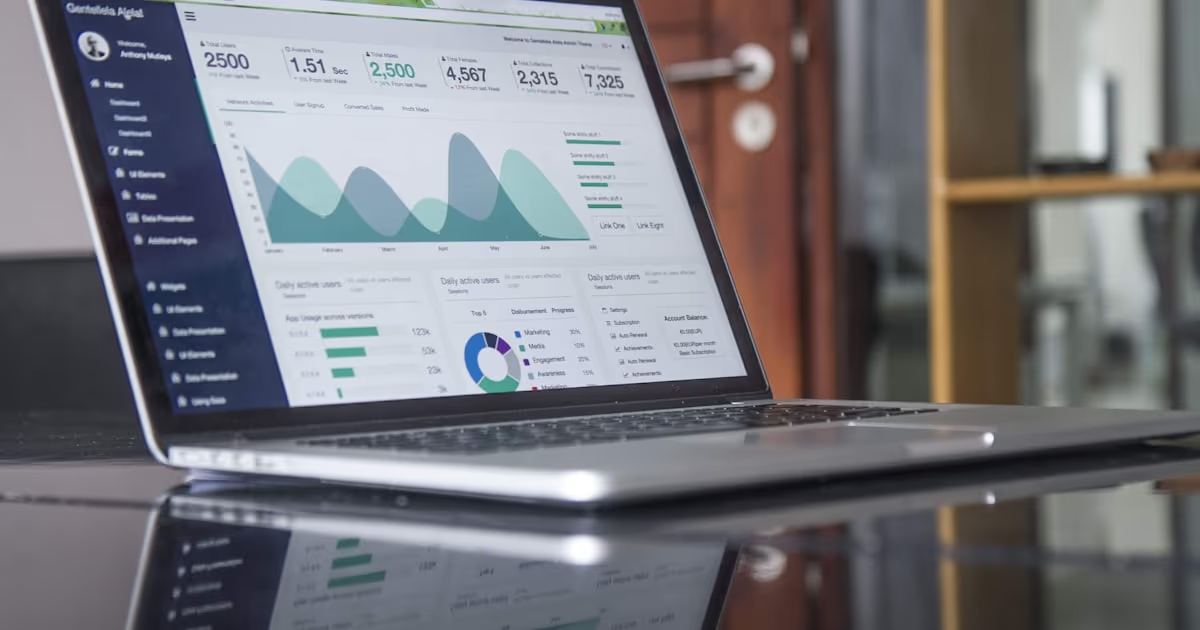
Visualization of the data plays an important role in user-friendliness. Modern systems provide intuitive dashboards that provide all relevant information at a glance. Graphical representations of temperature curves, status displays of the different measurement points and an overview of the last alarms enable quick and easy control. Mobile apps for smartphones and tablets also allow access to this information on the go and make temperature monitoring management even more flexible.
6. Integration into existing systems
For a holistic process optimization, the integration of temperature monitoring into other enterprise systems is useful. Many modern solutions offer interfaces (APIs) to link the temperature data, for example, to a goods management (ERP) or a warehouse management system (LVS). Thus, temperature data can be linked directly to certain batches or products, which further improves traceability.
7. Predictive Maintenance
Some advanced systems go one step further and use the collected data for predictive maintenance analyses. By analyzing patterns in the temperature course or in the energy consumption of a cooling unit, the system can point out possible technical problems or a threatening failure at an early stage. Maintenance work can be planned proactively and unplanned downtime can be avoided.
The advantages at a glance
**Increased food safety:**Increased control and immediate response to discrepancies minimise consumer risk.
Remaining high product quality: The optimal storage temperatures ensure the freshness and durability of the products.
** Increase in efficiency and time savings:** Automated processes significantly reduce manual effort for controls and documentation.
Cost reduction: Avoidance of goods loss due to timely alarming and reduction of personnel costs leads to direct cost savings.
Legal safety: Automatic and audit-proof documentation facilitates the detection of HACCP conformity in checks.
Process optimization: The analysis of the collected data covers optimization potentials throughout the cooling chain.
Conclusion: A must for modern food industry
Temperature monitoring in the food industry has developed from an annoying duty to a strategic tool for quality assurance and process optimization. Modern, IoT-based systems provide a wealth of functions that go far beyond the pure measurement and help companies to ensure the safety and quality of their products, meet legal requirements and at the same time increase their efficiency and efficiency. The investment in such a system is not only an investment in compliance with regulations, but also in the sustainability of its own company.
.**Look for an intelligent and reliable solution for temperature monitoring in your company? Hyperspace GmbH offers innovative and tailor-made systems for automated temperature monitoring as an experienced partner for digitalization solutions. Contact us for non-binding advice and learn how to help you optimize your processes. **
Related articles


Matching primary solution
For a deeper feature and rollout context, start from Franchise management software.