

Store Check in Omnichannel Age: Connect Online and Offline
Published on 15 June 2026 | Updated on 15 June June 2026
Reading time: 14 minutes
**The boundaries between online and offline trading are increasingly blurring. ** Customers expect a seamless shopping experience across all channels. For Store Checks this means new challenges and opportunities. In this article, you will learn how to adapt your store reviews to the omnichannel reality and integrate online and offline data for a holistic POS strategy.
What does Omnichannel mean for Store Checks?
In omnichannel trading, customers interact with brands and traders through multiple touchpoints: stationary shops, online shops, mobile apps, social media and more. These channels are not isolated, but are connected to one another. A customer can search online, buy in the store and give feedback via the app.
For Store Checks this means that the pure observation of the stationary POS is no longer sufficient. Linking to online data and taking into account cross-channel customer journeys is becoming increasingly important.
The Omnichannel perspective
Traditional Store Checks focus on the physical point of sale. The omnichannel context expands the view of the entire ecosystem: How is the product presented online? Do online and offline prices match? Does Click & Collect work smoothly?
New test points in the Omnichannel context
The omnichannel transformation requires an extension of the classic store checklist to new, cross-channel checkpoints.
Click & Collect
Does online order collection work smoothly? Is the pickup area well signposted? How long are the waiting times?
Price consistency
Do the prices in the business match the online prices? Are online actions also communicated stationary?
Availability display
Is the online availability display correct? Can customers rely on the information?
Digital Signage
Does digital displays work in business? Do you display current and relevant content?
Advanced test points in detail
** Area** Examination points Relevance
Online offline consistency Prices, assortment, promotions | Customer confidence |
Click & Collect Process, waiting time, signs | Customer satisfaction |
Ship from Store Accuracy, Picking Process | Delivery performance |
Endless Aisle Functionality, usage, integration | assortment extension |
Mobile integration | App functions in the store, QR codes | Digital Services |
Integration of online and offline data
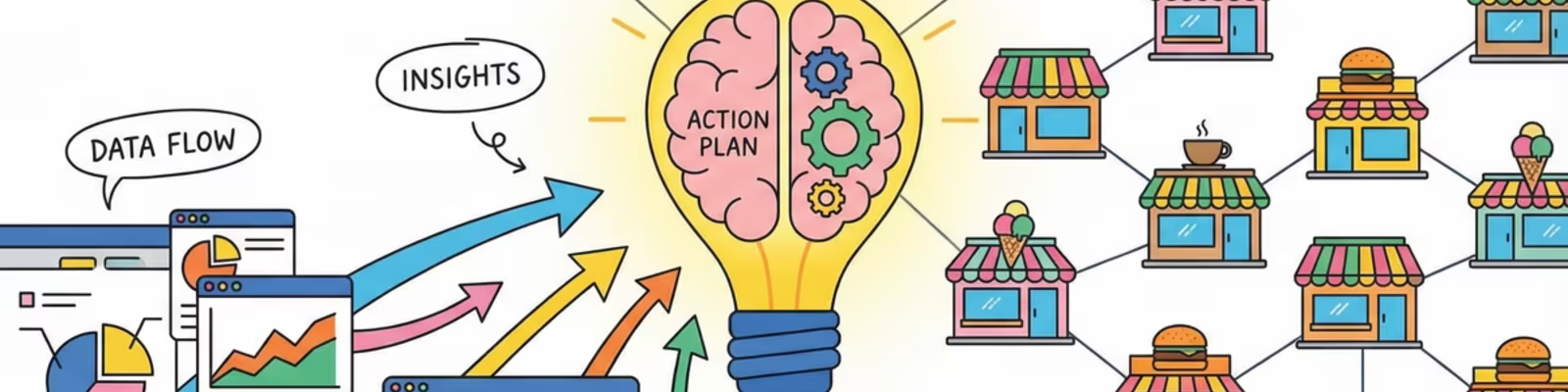
The true strength of the omnichannel approach lies in the integration of data from different sources. Store Check data is combined with online data to get a complete picture.
Data sources for integrated analyses
Store Check Data: Availability, Placement, Prices in Business
E-Commerce Data: Online availability, prices, reviews
POS data: Sales, transactions, goods baskets
**Customer data:**Customer history, preferences, feedback
Web Analytics: Search behavior, product views, conversion
Practical example: Integrated analysis
A product shows high online searches, but low sales in the store. The Store Check reveals: The product is listed, but badly placed and often out-of-stock. The combination of data allows the identification and solution of the problem.
The role of the business in the omnichannel mix
The role of stationary business changes in the omnichannel age. It is no longer just a point of sale, but also showroom, filling center and venue. Store Checks must take this extended role into account.
New functions of stationary trading
Showroom: Customers inform themselves in the shop and buy online.The product presentation must inspire and inform even if the purchase takes place later online.
Fulfillment Hub: Businesses become logistics centers for Click & Collect and Ship from Store. The accuracy and process efficiency are critical.
**The physical experience becomes the difference between pure online trading. Events, advice and services are gaining importance.
Service point: Returns, repairs and advice for online purchases take place in the business. Service quality becomes an important test point.
Technological Enabler
Various technologies allow the integration of online and offline worlds and should be taken into account at Store Checks.
Important Omnichannel Technologies
Unified Commerce Platforms: Central systems for inventory, prices and customer information across all channels
RFID: Real-time maintenance transparency for exact availability displays
Mobile POS: Flexible cash systems for improved customer service
Digital Signage: Dynamic Content and Personalization in Business
Beacon/Location Services: Location-based services and analyses
KPIs for Omnichannel Store Checks
The omnichannel perspective requires new KPIs that measure cross-channel performance.
KPI Definition Determination
price parity | Match Online/Offline Prices | Customer confidence |
Quality of availability | Correctity of online ad | Customer satisfaction |
Click & Collect Rate Share C&C of total orders Channel usage |
C&C waiting time Time from arrival to pickup | Service quality |
BOPIS Conversion Additional purchases at pickup | Cross-Selling |
Challenges and Solutions
The integration of online and offline data brings challenges that need to be addressed.
Data silos: Online and offline data are often in different systems. Solution: Investment in integrated platforms or middleware for data exchange.
Organizational separation: e-commerce and stationary trade are often separate departments. Solution: Cross-functional teams and joint KPIs.
Several speeds: Online prices change faster than offline prices. Solution: Automated processes for price synchronization.
Complexity: The number of test points increases. Solution: Priority and focus on the most important touchpoints.
Frequently asked questions
Do all shops have to offer the same omnichannel services?
Not necessarily. The omnichannel strategy can be differentiated by location type. Flagship stores may offer the full spectrum while smaller branches focus on core services.
How often should omnichannel inspections be checked?
Critical aspects such as price transparency and availability accuracy should be tested continuously or at least weekly. Other aspects can be integrated into the regular Store Check rhythm.
Who is responsible for Omnichannel Store Checks?
Ideally, a cross-functional team of e-commerce, stationary sales and operations. The responsibilities should be clearly defined to avoid gaps.
Conclusion: Omnichannel as a new reality
Omnichannel transformation is not an option, but necessity. Customers expect a seamless experience across all channels, and companies need to adapt their processes accordingly. Store Checks are an important tool to monitor and improve the omnichannel execution.
Expand your Store Checklists for Omnichannel inspections, integrate online and offline data and establish new KPIs for cross-channel performance. Make sure your brand is presented optimally across all touchpoints.
Ready for Omnichannel?
?Learn more about the practical implementation of omnichannel strategies and the integration of online and offline data in our further articles.
Related articles


Matching primary solution
For a deeper feature and rollout context, start from Store check software.