

Filialmanagement Retail: Implementation in Multi-Store environments
*Managing multiple retail outlets poses major challenges to businesses. An efficient organization and central control are crucial for success. In this article, you will learn how to implement modern store management in multi-store environments and what advantages arise from it. *
The Challenges in Multi-Store Retail
Whoever runs several branches knows the complexity: uneven processes, lack of transparency over stocks and sales figures as well as a high administrative effort. Employees in the individual branches are often overloaded with manual tasks that keep them from their main task: advice and support of customers. This leads not only to inefficiencies and higher costs, but also to lower customer satisfaction. Long waiting times, unavailable articles and poorly informed employees are the result.
In today's fast-paced time when online trading scores instant availability and fast delivery times, stationary traders can no longer afford such weaknesses. To remain competitive, they must create a seamless and positive shopping experience. This is precisely where modern store management begins.
What is branch management software?
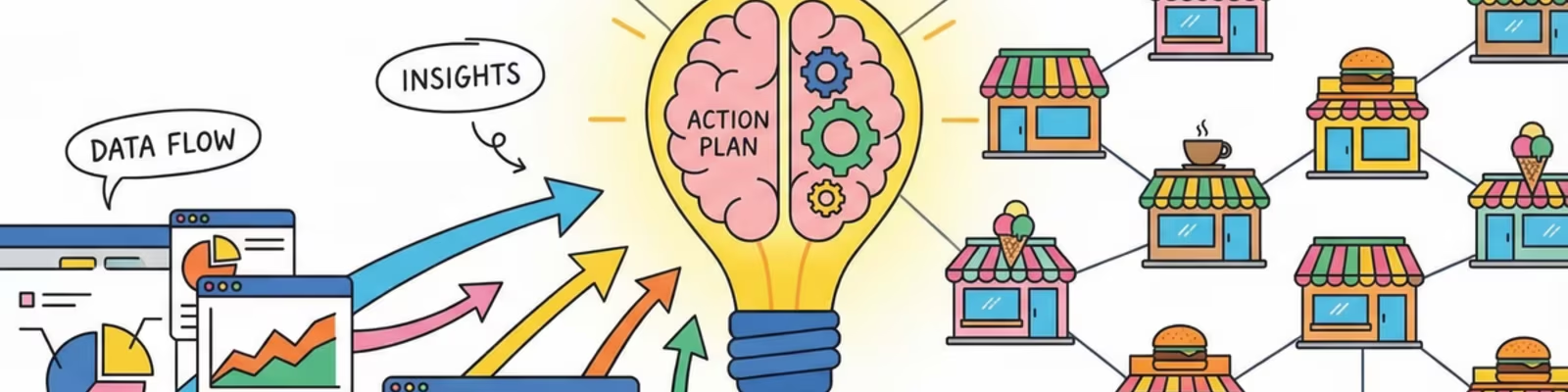
Filial management software is a central platform that allows retailers to control, standardize and optimize all processes and processes across multiple locations. It bundles information from all branches and provides it in real time. This provides a comprehensive overview of all relevant key figures for both the central and local staff.
The core functions of such software include:
Central inventory management: Real-time insight into the stocks of all branches, automatic reorders and optimized goods distribution.
** Task and Process Management:** Standardization of workflows, assignment of tasks to employees and control of progress.
** Employee management:** Personnel deployment planning, time recording and communication.
Sales and performance analysis: Detailed evaluations of sales figures, customer frequencies and employee performance.
Communication: Direct and rapid exchange of information between the headquarters and the branches as well as branches among each other.
The implementation: A step-by-step guide
The introduction of a branch management software is a strategic project that must be well planned. An overthrown implementation without clear goals and without taking employees is condemned to failure. The following steps help in successful implementation:
*Requirement analysis and target definition: * Define clear goals you want to achieve with the software. Do you want to increase the stock turnover frequency, lower staff costs or increase customer satisfaction? Analyze your existing processes and identify the areas with the greatest optimization potential. From the very beginning, involve employees from branches in this process, because they know the daily challenges best.
Selecting the right software: The market for branch management software is large. Compare different providers and pay attention not only to the functionality, but also to aspects such as ease of use, integration into your existing IT landscape (ERP, cash system), scalability and support offered. A German provider can offer advantages in terms of data protection and legal certainty.
Pilot phase: First run the software in one or a few pilot locations.So you can test the solution in practice, iron out children's diseases and collect valuable feedback from employees. This step-by-step approach minimizes risk and increases acceptance throughout the company.
** Employee training:** An intuitive user interface is important, but a comprehensive training of employees is essential. Not only do you show them how the software is serviced, but also convey the advantages that arise for their daily work. When employees recognize the benefits, they will use the new solution motivated.
*rollout and continuous optimization: * After a successful pilot phase, the rollout can take place in all branches. But even after implementation, the project is not completed. Analyze the use of the software continuously, get regular feedback and make adjustments if needed. A good branch management system continues to develop with your company.
The advantages of a central store management
The investment in a modern store management software pays off in many ways:
** Increased efficiency:** By automating routine tasks and standardizing processes, the administrative effort is significantly reduced. Your employees have more time for the customer.
Optimised stocks: A central overview of all stocks allows a demand-based distribution of goods. Overstocks and sales are minimized.
**More decisions:**Recovered decisions based on real-time data replace abdominal feeling. You can respond faster to market developments and customer requests.
High customer satisfaction: Well-informed employees, high availability of goods and shorter waiting times lead to a positive shopping experience and bind customers in the long term.
Motivated employees: Relieving troublesome routine tasks and clear communication enhance the satisfaction and motivation of your employees.
The future of retail: Technology as key to success
Digitization has changed the retail sector in a sustainable manner and will continue to be the driving force for innovation in the future. Customers expect a personalized and seamless shopping experience that melts online and offline. Technologies such as artificial intelligence (AI), the Internet of Things (IoT) and Big Data Analytics are opening up completely new possibilities here.
AI-based systems can, for example, help to analyse the purchasing behaviour of customers and to play out personalized recommendations. IoT sensors in the branches provide valuable data on customer flows and the dwelling time in specific areas. This information can be used to optimize the store layout and improve product placement.
A modern branch management system is the basis for using these technologies profitably. It acts as a central data disk that bundles all information and provides it for analysis. Thus, traders can not only optimize their operating processes, but also make strategic decisions on a solid database.
More than just efficiency: The focus of man
However, a decisive factor must not be forgotten in all technologization: man. Personal advice and human contact are still important differences between stationary trade and the pure online business. A store management software should therefore not be seen as a substitute for the employees, but as a tool that supports them in their work.
By automating administrative tasks and making information easily accessible, the software creates spaces for the employees.You can focus on what they can best do: advise customers, make products reliveable and build a personal relationship. This leads not only to higher customer satisfaction, but also to a stronger employee retention.
The implementation of a branch management solution is therefore also an important contribution to the evaluation of the professional image in retail. Employees become competent consultants and brand ambassadors from pure "regal fillers". This is not an underestimating advantage in times of shortage of skilled workers.
Conclusion: The Way to a Futureable Filial Network
The successful implementation of a branch management system is a decisive step for retailers with multiple locations to compete. It is not just about introducing a new software, but about creating the entire organization more efficiently, more transparent and customer-oriented.
If you want to make your branches sustainable and fully exploit the potential of a central management, a powerful and flexible software is the basis. With its expertise in retail software, Hyperspace GmbH offers tailor-made solutions that seamlessly integrate into your processes and help you successfully control your multi-store environment.
Related articles


Matching primary solution
For a deeper feature and rollout context, start from Franchise management software.