
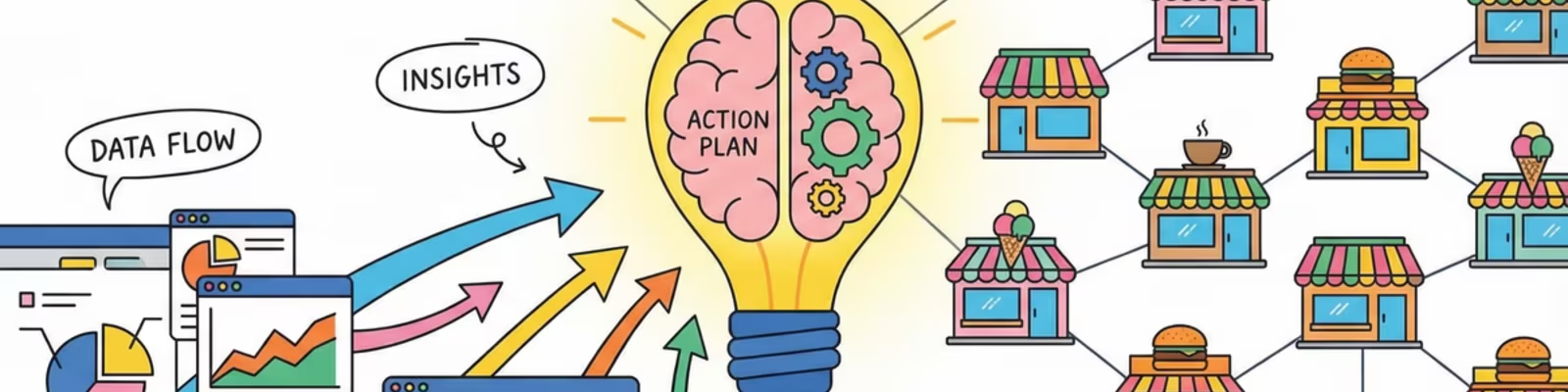
Franchise CRM Integration: Creating seamless connections to ERP, marketing and accounting
In the dynamic world of franchising, companies face the unique challenge of maintaining uniform brand standards and operational excellence across a decentralized network of independent partners. While the franchise model offers enormous growth potential, it also brings considerable complexity in managing data, processes and communication. From lead generation to new franchisees, the daily management of the sites to ensuring consistent customer experience – the flow of information is crucial. But this information is too often caught in isolated systems, leading to inefficiencies, mistakes and missed opportunities. Here, the integration of customer relationship management (CRM) systems, especially for the requirements of franchise companies, comes into play. An integrated Franchise CRM is not only a tool for customer management, but the pulsating heart of a connected and successful franchise ecosystem. The seamless connection to key business applications such as Enterprise Resource Planning (ERP), marketing automation tools and accounting software is the key to enabling scalability, maximize efficiency and build sustainable brand strength. This guide highlights the strategic necessity of these integrations and shows how they lay the foundation for future growth.
What is a franchise CRM and why is it indispensable?
A Franchise CRM is a specialized software solution that goes far beyond the functionality of a conventional CRM system. While a standard CRM is primarily designed for managing end customer relationships, a CRM for franchise companies addresses the dual target group of the franchise system: the franchisees and their end customers. It acts as a central platform specifically designed to control, standardize and optimize the complex relationships and processes between the franchisor and its partners. It is the digital link that promotes transparency and cooperation throughout the network.
In essence, such a solution of generic systems differs by its ability to reflect the hierarchical structure of a franchise company. It offers functions tailored to the specific needs of the franchise life cycle – from recruitment and onboarding of new franchises, ongoing support and performance management to contract management and billing. A comprehensive Franchise Management Software typically integrates modules for the lead management of franchises, a central communication portal for the exchange of best practices and important announcements, tools for monitoring the operational and financial performance of individual locations, as well as functions for managing marketing materials and ensuring brand consistency. The inconsistency of such a specialized solution is obvious: it allows the franchisor to effectively scale his network without losing control of brand identity and service quality. For franchisers, it offers the necessary tools and support to be successful on site, and strengthens the feeling of being part of a well-organized and powerful system.
The strategic importance of system integration in franchising
The introduction of a franchise CRM is the first step. However, it only develops its full potential through strategic integration with the other central software systems of the company.In the fragmented IT landscape of many franchise organizations, data silos quickly emerge – isolated information islands in departments such as sales, marketing, operation and finance. These silos not only impede internal cooperation, but also lead to an inconsistent and incomplete picture of business performance and customer interactions. The integration of the systems is the strategic lever to break these barriers.
Silos break up: The way to a uniform database
The core problem of data silos is that valuable information is not available where it is needed. Marketing may not have access to the latest sales data from the ERP, sales does not know the service history of a customer from the ticket system and the financial department must manually compile data from different sources. The integration, led by Franchise CRM as a central node, creates a single source of turkey. All relevant data on franchises, end customers, campaigns, sales and finances are combined in a single system. This allows a real 360-degree view of every aspect of the business. Franchiseers can evaluate the performance of their partners holistically, while franchisees receive a complete picture of their customers, leading to better service and more targeted sales activities.
Increase efficiency and process automation
Manual data transmissions between systems are not only time-consuming, but also one of the most common sources of errors in business operations. An employee who copies customer data from an email list to the CRM and from there to the billing system can easily make mistakes that lead to incorrect invoices, angry customers or faulty reports. System integration automates these processes. If, for example, a new customer makes a request via a franchise's website, this information can be automatically entered in the CRM for franchise companies, assigned to the correct location and at the same time a corresponding order can be created in the ERP system. Such automated workflows drastically reduce administrative effort, minimise errors and give employees more time for value-generating activities – both in the central and in the franchise partners.
Ensuring brand consistency across the network
One of the biggest challenges in franchising is to maintain a uniform brand presence across all locations. Inconsistent advertising messages, outdated marketing materials or different pricing strategies can sustainably harm the brand image. An integrated system landscape in which the CRM is connected to the marketing tools provides the franchisor with the necessary control. Central marketing campaigns can be rolled out via the platform and easily adapted and used by franchisees. The franchisor can ensure that only released templates and materials are used. At the same time, the CRM provides valuable data on the customers of the individual partners who enable central marketing to develop more effective and target-group-specific campaigns that benefit the entire network and strengthen the brand as a whole.
The core integrations: Franchise CRM in interaction with other systems
The theoretical advantages of an integrated system landscape are realized in practice by concrete interfaces between the Franchise CRM and other mission-critical applications. These connections create an ecosystem in which data flow smoothly and processes are intelligently automated.
CRM and ERP systems: Connecting the operating backbone
The integration between the CRM and the Enterprise Resource Planning (ERP) system is probably the most fundamental.It connects the customer-oriented processes of sales and marketing with the operational backend processes such as order processing, warehouse management and financial accounting. Typically, customer master files, quote and order information, product data as well as invoice and payment information are synchronized. The advantage is a continuous and transparent process from the first customer request to the final invoice position. If a seller marks an order in CRM as "pure", the ERP system can automatically create the order, check the availability of the products, initiate the shipping process and finally generate the invoice. This not only improves the efficiency of order management, but also provides management with a clear overview of sales, open items and stocks throughout the franchise network in real time.
CRM and Marketing Automation: Personalized Large Style Customer Address
The connection of the CRM with marketing automation platforms (such as email marketing tools, social media management systems or landing page generators) is crucial to implement the customer data collected in the CRM into effective marketing measures. By synchronizing, marketing teams can create detailed customer segments based on demographic data, purchasing history or interaction behavior that originate directly from the CRM for franchise companies. This allows a highly personalized customer approach. Instead of generic mass e-mails, targeted campaigns can be sent to specific target groups – for example a special offer for customers who have not bought anything in the last six months, or an information campaign for leads in a specific region. In addition, the integration allows a closed success control (closed loop reporting) in which the reactions to a campaign (e.g. clicks, conversions) are played back into the CRM and assigned directly to the respective customer profile. The Return on Investment (ROI) can be precisely measured by marketing activities and optimized for future strategies.
CRM and accounting software: Optimizing financial processes
The integration of CRM with accounting software automates and simplifies numerous financial processes. The synchronization of customer and contract data ensures that invoices are always correct and addressed to the correct contact person. When a sale is completed in the CRM, the accounting software can automatically create an invoice and monitor the payment receipt. This considerably accelerates the cash flow and reduces the manual effort in accounting. Especially in franchising, this integration is valuable for the automation of complex commission and fee accounting. Based on the sales data of the franchisees recorded in the CRM, the system can automatically calculate the due franchise fees, advertising fees or royalties and create the corresponding credits or invoices. This creates transparency and confidence between franchisors and customers and ensures faultless and punctual financial reporting.
Best Practices for Successful Franchise CRM Integration
An integration project is more than just a technical exercise; it is a strategic project that requires careful planning, correct technology and comprehensive change management. To avoid falling knits and to draw maximum benefits from networking your systems, consider the following best practices.
Step 1: Demand analysis and strategy development
Before only one line of code is written, a thorough analysis of the existing processes and system landscape must take place.Identify the most painful inefficiencies and the greatest opportunities that could arise through integration. What data must flow between which systems to achieve these objectives? Define clear, measurable goals (KPIs) for the project. Do you want to reduce the billing time by 50%? Increase the lead conversion rate by 15%? From the start, involve all relevant stakeholders – from IT department to marketing and sales to franchiseers themselves. Your input is crucial to ensure that the integrated solution meets the actual needs of users.
Step 2: Selection of the right technology and partners
Choosing Franchise Management Software is one of the most critical decisions. Pay attention not only to the core functions, but especially to the integration capabilities of the platform. Does the software offer native, pre-configured, integrations to the ERP and accounting systems you use? Does it have a well documented and flexible API (Application Programming Interface) that allows individual connections? Sometimes the use of middleware – a special software that acts as a mediator between different applications – can also be useful. Equally important is the choice of the implementation partner. Search for a service provider with proven experience in the integration of CRM systems, ideally in the franchise environment. A good partner understands not only the technology but also your business processes and can strategically advise you.
Step 3: Data management and gradual implementation
The quality of the data exchanged between the systems is crucial for the success of integration. "Garbage in, garbage out" – this principle applies unconditionally here. Therefore, plan enough time and resources for data purification and migration. Dublets must be removed, outdated information updated and data formats standardized. Instead of a "Big Bang" approach, in which all integrations are switched live at once, a step-by-step approach has proven itself. Start with a pilot project, for example the integration of the CRM with the email marketing tool for a small, selected group of franchises. Collect experiences, optimize the processes and then gradually roll out the solution across the entire network. This agile procedure minimizes risk and increases acceptance.
Step 4: Training and support for the entire network
The best technology is useless if people do not know how to use it effectively. A comprehensive training concept is therefore essential. School not only the operation of the software, but above all the new, integrated processes. Show the franchisees and the staff in the central office what benefits the new way of working for their everyday life. Join the introduction with a proactive change management and communicate the strategic importance of the project. Also set up a clear support system. Users must know who they can contact in technical problems or application issues. A well-achievable and competent support is crucial for the long-term acceptance and success of the integrated system landscape.
Conclusion: The future of franchise management is integrated
The digital transformation has redefined the rules of play in franchising. In an increasingly competitive environment, the ability to intelligently use data and to efficiently design processes is no longer a luxury, but a need for survival.The integration of a powerful Franchise CRM with the operating pillars of the company – ERP, Marketing and Accounting – is the decisive step in raising this potential. It breaks data silos, automates workflows, strengthens brand consistency and creates a transparent, data-based basis for strategic decisions.
Companies investing in a networked system landscape are not only equipping themselves for the current challenges, but also for the future. The uniform data base is the foundation for further innovations such as AI-based analyses for predicting market trends or the integration of IoT data to optimize operating operations. In the end, the investment in an integrated Franchise Management Software is an investment in scalability, resilience and future viability of the entire franchise network. It is the key to growing as a system without losing the connection to the individual partners and their customers – and thus the decisive competitive advantage in the modern franchise economy.
References
- Marr, B. (2022). The Importance Of Data Integration For Business Success. Forbes.
International Franchise Association. (2023). Franchise Business Economic Outlook.
Gartner. (2023). Magic Quadrant for CRM Customer Engagement Center.
Main article: [Franchise CRM: The ultimate implementation guide for franchisers](/blog/franchise-crm-franchise-crm-der-ultimative implementation guide thread)
Related articles


Matching primary solution
For a deeper feature and rollout context, start from Franchise management software.