
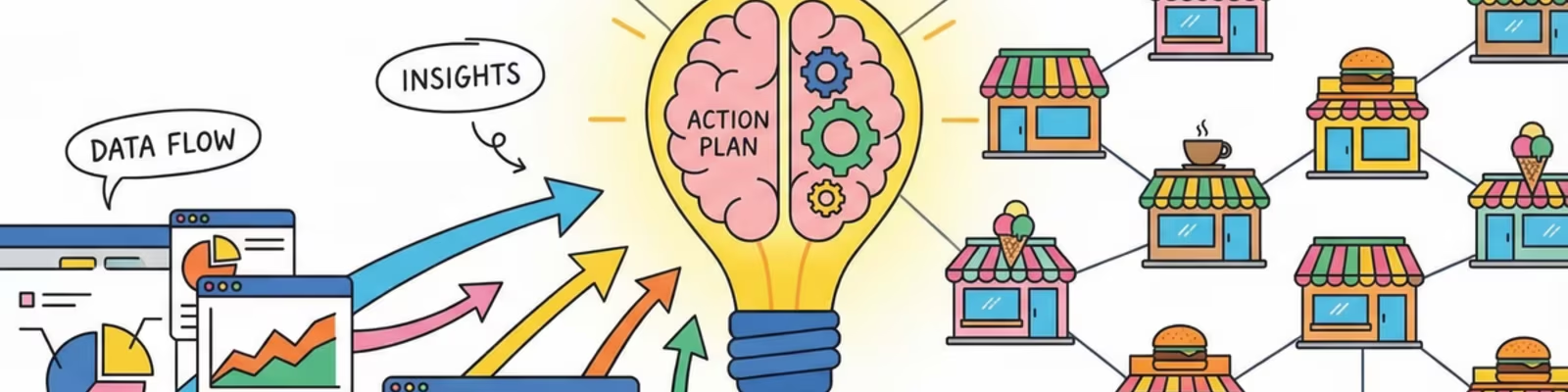
Franchise CRM for gastronomy: Industry-specific requirements and solutions
Introduction: Why a specialized CRM is essential for franchise gastronomy businesses
The gastronomy industry is always a tough market. For franchise companies in this sector, the challenges are growing again. You need to master not only the daily operation at numerous locations, but also a uniform brand experience, consistent quality and efficient processes across the entire network. In this complex environment, a specialized Franchise Management Software becomes a decisive competitive advantage. A powerful Franchise CRM is the heart of such a solution.
The unique challenges of franchise companies in gastronomy
Franchise systems in gastronomy are facing a set of specific challenges that go far beyond one restaurant. This includes maintaining brand consistency across all locations, central management of marketing campaigns, compliance with quality standards and efficient communication between franchisers and franchisers. At the same time, they must understand and serve the individual needs of the guests at each individual location. A lack of centralized data and processes quickly leads to inefficiencies, inconsistent customer experiences and ultimately to a loss of revenue.
What is a franchise CRM and how is it different from a standard CRM?
A customer relationship management (CRM) system is a software for managing customer relationships. While a standard CRM focuses primarily on the interactions with end customers, a CRM for franchise companies continues a decisive step. It is designed to map and manage the complex relationships within a franchise network. This means that it supports not only the relationship with the guest, but also the communication and the processes between the franchisor and the individual franchisees. A Franchise CRM thus provides a 360-degree view of the entire franchise system and allows central control while simultaneously providing local flexibility.
Core Requirements for a Franchise Management Software in Gastronomy
Choosing the right Franchise Management Software is crucial for the success of a gastronomy franchise system. An effective solution must meet a number of industry-specific requirements to optimally support both the franchisor and the franchisees. The central requirements for a Franchise CRM in gastronomy will be explained in detail below.
Central management of customer data and interactions
A basic feature of each CRM system is the central collection and management of customer data. For a CRM for franchise companies in gastronomy, this means that all information about guests – from contact data to order history and preferences to feedback – are stored in a central location and made accessible to all relevant parties. This allows to create a personalized and consistent guest experience across all locations. A guest who has had a positive experience in a chain restaurant in Hamburg should also be recognisable in a restaurant of the same chain in Munich and can be served according to his preferences.
Marketing automation and personalized guest communication
Effective marketing is essential for attracting and binding guests. A modern Franchise CRM offers extensive functions for marketing automation.These include automated sending of newsletters, personalized offers on birthdays or other occasions, loyalty programs and targeted campaigns for reactivating inactive guests. Through the central control of these activities, the franchisor can ensure that the brand message is uniformly communicated while the franchisees benefit from professionally designed and effective marketing measures that they can implement with little effort.
Franchise-specific functionalities
A CRM for franchise companies must go beyond standard CRM functions and cover specific requirements of franchise systems. This includes, for example, a module for managing franchises in which all contractual information, communication protocols and performance data of the individual partners are documented. Also important are functions for central control of menus, prices and actions, which can then be rolled out to the individual locations. Such a system facilitates compliance with standards and efficient control of the entire network.
Integrations with cash systems and other gastronomy software
The gastronomy landscape is characterized by a variety of specialized software solutions, especially the POS. A powerful Franchise CRM must have open interfaces (APIs) to enable seamless integration with these systems. Only in this way can data from the operating business, such as orders and sales, flow directly into the CRM system and be used for analysis and marketing activities. Other important integrations concern reservation systems, personnel planning tools and goods management systems.
Reporting and analysis for franchisers and consumers
Data is the gold of the 21st Century – this also applies to gastronomy. A Franchise CRM must provide comprehensive reporting and analysis functions that provide valuable insights to both the franchisor and the franchisees. The franchisor needs a complete overview of the performance of the entire network to make strategic decisions. The franchisees in turn need detailed evaluations about their own operation to evaluate their performance and identify optimization potentials. Important key figures (KPIs) in this context are, for example, table utilization, average order value, no-show rates for reservations and customer satisfaction.
The best Franchise CRM solutions for gastronomy at a glance
The market for Franchise Management Software is diverse and offers a wide range of solutions that differ in their range of functions, scalability and pricing models. The selection of the right provider is a strategic decision that should be carefully weighed. Below we present some of the leading solutions and compare them with the previously defined requirements.
Presentation of different providers
Salesforce: As one of the world's leading CRM providers, Salesforce offers a highly customizable and scalable platform with its Sales Cloud, which is also suitable for large catering franchise chains. Salesforce's strength lies in the enormous flexibility and the huge ecosystem of partner apps in the AppExchange.
HubSpot: HubSpot is known for its user-friendly all-in-one platform that combines marketing, sales and service. For gastronomy franchises, HubSpot offers an attractive combination of powerful automation functions, easy operation and a flexible pricing model that is also suitable for smaller and medium-sized companies.
.- Microsoft Dynamics 365: For companies that are already strongly anchored in the Microsoft ecosystem, Microsoft Dynamics 365 can be an obvious choice. The deep integration with Office 365, teams and Power BI allows a continuous process landscape.
- Specialized provider: In addition to the major generalists, there are also a number of providers specializing in gastronomy or even in franchise systems. These often offer industry-specific functions that can only be realized with the large providers via adjustments or add-ons.
Comparison of solutions based on defined requirements
** Provider** Central customer data management | Marketing automation Franchise functions | Integrations Reporting & analysis Ideal for
Salesforce Very strong | Very strong | About adjustments/apps | Very good Very strong | Large, complex franchise systems |
Hubspot Strong Very strong | Good Good Strong Small to large franchise systems, focus on marketing & sales |
Microsoft Dynamics 365 Strong Strong About adjustments/apps | Very good (in the MS ecosystem) | Very strong | Companies that already use Microsoft products |
Specialized provider | Often very good Variabel | Very strong | Variabel | Often good | franchise systems that are looking for an out-of-the-box solution |
Implementation of a Franchise CRM: A Guide to Success
The introduction of a new Franchise Management Software is a complex project that needs to be carefully planned and implemented to be successful. A structured approach helps to avoid falling knitting and to ensure that the new solution is accepted and effectively used by all parties involved.
The right steps to choose and introduce
Requirement analysis: Define clear and detailed requirements for the new system. Please include both the needs of the franchisor and the franchisor.
**Market evaluation:**Research different providers and compare their solutions based on your defined criteria. Request demos and use free test phases to get a feeling for the systems.
Pilot Project: First run the selected system in one or more pilot locations. Collect feedback and customize the configuration if needed.
Rollout: Plan the rollout over the entire franchise network carefully. Make sure all locations have the necessary technical requirements.
Training and onboarding of employees
The best software is useless if employees do not know how to use it. A comprehensive training and well planned onboarding are therefore crucial for the success of the CRM introduction. Develop a training concept tailored to the different roles and tasks of the employees. Offer both online training and presence events and ensure that a contact person is available for questions even after the introduction.
Conclusion: With the Right Franchise CRM To Success
A specialized Franchise CRM is more than just a useful tool for gastronomy franchise companies today – it is a strategic success factor. It not only allows more efficient management of the entire network, but also significantly contributes to creating a consistent and personalized guest experience. The investment in the right Franchise Management Software pays off by more satisfied guests, more loyal franchises and ultimately by higher sales.The careful selection and implementation of such a solution is therefore one of the most important tasks for every future-oriented franchisor in gastronomy.
References
[1] HubSpot. (2025). The 6 best CRM systems for gastronomy compared (2025). Retrieval of blog.hubspot.de
Main article: [Franchise CRM: The ultimate implementation guide for franchisers](/blog/franchise-crm-franchise-crm-der-ultimative implementation guide thread)
Related articles


Matching primary solution
For a deeper feature and rollout context, start from Franchise management software.