
Temperature monitoring Food: Efficient implementation of digital sensors for complete safety
Published on 24. February 2026
In the food industry, compliance with the cooling chain is not only a matter of quality, but a decisive factor in food safety and compliance with legal regulations. Complete temperature monitoring is essential in order to prevent the reproduction of microorganisms and to ensure the freshness and durability of foodstuffs. However, the manual control and documentation of temperatures is time-consuming, error-prone and often no longer meets the modern requirements for efficiency and traceability. The solution lies in the digital transformation: The implementation of digital sensors and automated monitoring systems revolutionises quality management in food production, storage and logistics.
The importance of temperature monitoring in the HACCP concept
The HACCP concept (Hazard Analysis and Critical Control Points) is an internationally recognised standard for ensuring food safety. It calls for a systematic analysis and control of all potential risks in the production process. The temperature control is one of the most critical control points (CCPs). Deviations from the predetermined temperature ranges can promote the growth of pathogenic germs and impair the quality of the products. Precise and continuous temperature monitoring is therefore a central component of any functioning HACCP system. The legal requirements as laid down, for example, in EU Regulation (EC) No 852/2004 on food hygiene require complete documentation of temperature data. These records serve not only for internal control, but must also be submitted for official checks.
Limits of manual temperature control
In many plants, the temperatures are still measured manually with thermometers and entered in lists. However, this procedure has numerous disadvantages:
Time: Regular controls bind valuable working hours of employees who could be used more meaningfully elsewhere.
Currority: Human errors when reading, entering or transferring the data are unavoidable and can lead to complete or faulty records.
Reaction in real time: Temperature deviations are often only detected at the next manual control. In the meantime, the cooling chain may have been interrupted for a longer period of time, which jeopardises the quality and safety of the foods.
Common documentation and evaluation: Manual evaluation of paper lists is laborious and makes it difficult to identify trends or recurring problems.
The solution: Digital sensors and automated monitoring
The implementation of digital sensors combined with an automated monitoring system provides a modern and efficient solution for the challenges of temperature control. These systems usually consist of the following components:
Digital temperature sensors: These sensors, often designed as wireless WLAN or Bluetooth loggers, are placed at the critical control points, for example in cooling and freezing rooms, in cooling counters or during transport. They record the temperature at regular predefined intervals.
Data transfer: Data collected will be transferred automatically and in real time to a central software or cloud platform.
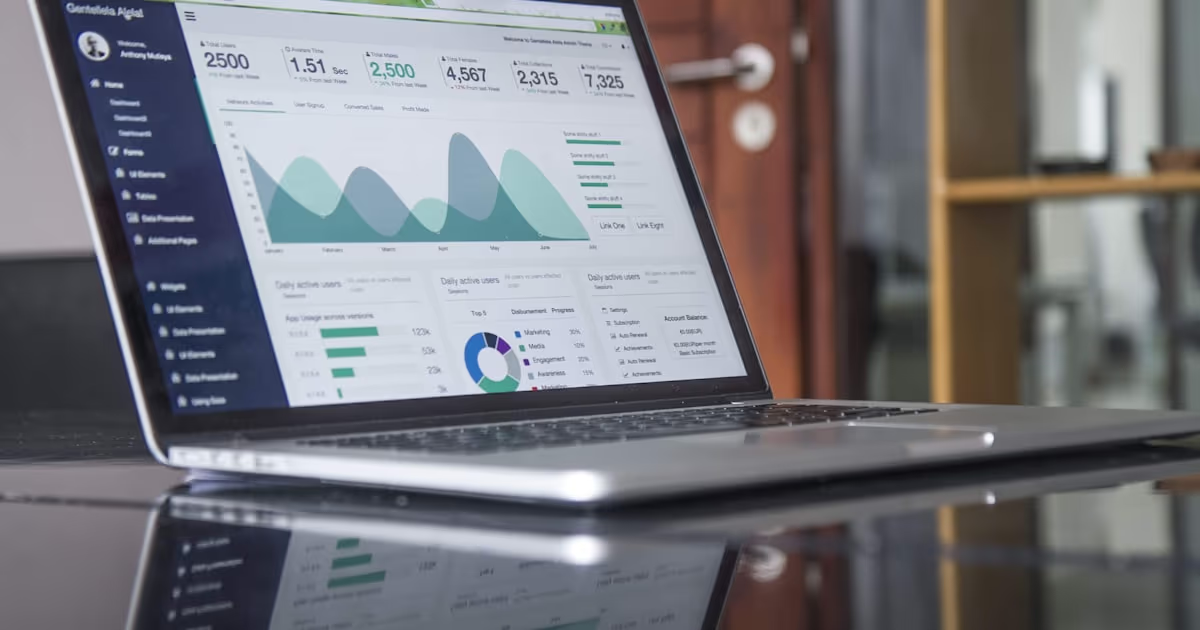
Software/Cloud Platform: The software serves to store, visualize and analyze temperature data.It allows the creation of reports, complete documentation according to HACCP requirements and configuration of alarms.
The advantages of digital temperature monitoring
The transition to a digital system offers a variety of advantages that go far beyond the pure compliance of legal regulations:
Noise and tamper-proof documentation: The automatic recording of all temperature data ensures complete and undistorted documentation that can be retrieved at any time.
Real time alarm: If the defined limit values are below or exceeded, an alarm is immediately triggered, for example by e-mail or SMS. This allows rapid intervention before it comes to quality loss or spoilage.
Efficient increase and cost reduction: The absence of manual controls saves valuable working time. In addition, expensive goods losses can be avoided by the early detection of problems, such as a falling cooling unit.
Transparency and traceability: The digital capture enables a complete traceability of the cooling chain from the goods receipt to the sale. This creates confidence among customers and partners.
Simplified analysis and optimization: The collected data can be easily analyzed to optimize, for example, the energy consumption of cooling devices or identify recurring problems.
Deepening: types of digital sensors and their application areas
The selection of the right sensor type is crucial for effective temperature monitoring. Modern digital sensors offer a wide range of possibilities tailored to specific requirements:
WLAN sensors: These sensors connect directly to the existing WLAN network and send the data to the central software in real time. They are outstandingly suitable for stationary applications in cooling and storage rooms because no additional cabling is required.
Bluetooth Low Energy (BLE) sensors: BLE sensors are particularly energy-efficient and are ideal for use in mobile environments, such as delivery vehicles or monitoring individual food transport boxes. The data are usually sent to a gateway or directly to a mobile terminal.
NFC sensors (Near Field Communication): These passive sensors do not require their own power source. They are activated by an NFC-enabled reader (e.g. a smartphone) and transmit the stored temperature data when contact is made. They are a cost-effective solution for monitoring products during transportation and storage.
Injection sensor: Special injection sensors are essential for measuring the core temperature of food. These robust sensors enable precise control of the temperature inside meat, fish or other solid foods.
The role of the cloud platform in modern temperature management
The true strength of digital surveillance systems develops in connection with a powerful cloud platform. These platforms offer far more than just the pure data storage:
Central data access: All temperature data is available at any time and from any location via a web browser or mobile app. This allows cross-site monitoring and control.
Automatized reporting: The platform automatically generates HACCP-compliant reports that can be sent by email or exported as PDF. This saves considerable administrative effort.
Advanced analysis functions: Modern cloud solutions use algorithms to analyze the data collected. Thus, trends such as a slowly increasing energy consumption of a cooling device can be detected at an early stage, which enables predictive maintenance.
.- Scalability and flexibility: Cloud-based systems are simply scalable. New locations, cooling rooms or vehicles can easily be integrated into the existing system. In addition, they often provide interfaces (APIs) for connection to other enterprise software, such as goods management or ERP systems.
Conclusion: Investment in security and efficiency
The implementation of digital sensors for temperature monitoring is a future-proof investment for every company in the food industry. It not only ensures compliance with strict HACCP requirements, but also increases efficiency, reduces costs and minimizes the risk of goods loss. Complete documentation and real-time alarming provide maximum safety and transparency along the entire cooling chain.
If you want to digitize your temperature monitoring and lift your quality management to a new level, Hyperspace GmbH is your competent partner. With our expertise in implementing IoT solutions and sensor technology, we develop customized systems that are perfectly tailored to your individual requirements. Contact us for non-binding advice and learn how to benefit from digital temperature monitoring.
© 2026 Hyperspace GmbH. All rights reserved.
Related articles



Matching primary solution
For a deeper feature and rollout context, start from Franchise management software.