
Franchise Software & Store Checks in Ulm
Your partner for franchise management in Ulm, Baden-Württemberg
hyperspace in Ulm
Baden-Württemberg • approx. 130.000 inhabitants
Ulm has the world's tallest church tower. The science city is known for innovation, research and a strong economy. We support franchise systems and multi-site businesses in Ulm with our cloud software for store checks, audits and quality management. With hyperspace you keep all branches in view.
Franchise operations, quality and branch governance in Ulm
Ulm in Baden-Württemberg combines approx. 130.000 inhabitants with economically relevant clusters such as Research, Automotive, Pharma, IT. For franchisors and quality leaders the decisive question is how to keep standards comparable when branches face different rent levels, staffing availability and customer expectations—especially where leading industries intersect with retail, food service and regulated processes.
Ulm has the world's tallest church tower. The science city is known for innovation, research and a strong economy.
The local economy matters because each sector drags specific checkpoints into audits: retail asks for presentation and compliance topics, food businesses emphasise hygiene and cold-chain traceability, services emphasise appointment quality and data handling. Ulm therefore needs franchise software that connects structured inspections with partner records, tasks and analytics rather than isolated spreadsheets.
Baden-Württemberg pairs global industrials with a strong Mittelstand—many franchise brands originate here or run sizeable branch footprints from Stuttgart to Freiburg. Quality programmes must tie KPI from audits to corrective actions without spreadsheet chaos.
Ulm blends research with strong retail—multi-site operators pursue comparable assurance and processes. Franchise software for store checks and audits supports that. hyperspace provides branch management with digital audits and central documentation for every site.
From headquarters you scale only when partner management, documentation and quality controls share one data model. hyperspace bundles CRM-style partner files, digital audits, mystery programmes and corrective actions so decision-makers see where standards hold—and where coaching, capex or policy updates must follow.
Why Baden-Württemberg and Ulm matter strategically: universities, clusters and anchor employers influence labour markets and customer flows. When benchmarks compare similar branches, leadership can separate structural issues (equipment, training curriculum) from market noise. Quality management therefore becomes steering information—not merely paperwork.
Branch networks in Ulm benefit when audits produce structured outcomes that link to CRM history, mystery scores and tasks. That linkage reveals whether deviations stem from training gaps, weak execution or external factors—critical when brand promises must stay uniform.
Operationally hyperspace reflects how German franchise HQs work: digital partner files, controlled documents, measurable audits and traceable CAPA loops. Teams across Ulm can reuse identical mobile workflows as elsewhere—permissions simply gate what franchisees should see.
Another lever is combining supplier or assortment signals with inspections: where Research, Automotive, Pharma, IT influence shelf or kitchen realities, audits should capture context—not only red/green scores—so investments target true root causes.
Decision-makers ultimately ask how measurable standards survive partner growth. hyperspace targets that scale—from pilots to nationwide rollouts—with reporting, escalation queues and benchmarking baked into one SaaS stack hosted in Germany.
Typical advantages referenced for locations like Ulm: Science city; Innovative; High purchasing power. Software converts those strengths into faster pilots, clearer priorities for field teams and fewer hand-offs between email, tickets and Excel trackers.
Franchise systems from Ulm use hyperspace for assurance and branch controlling.
Where gastronomy, food processing or cold chains matter—as is common when retail and hospitality dominate—HACCP-style documentation and alert feeds must plug into the same platform so franchisees avoid juggling multiple apps. hyperspace keeps comparisons fair across branches.
From a GEO and analytics angle, structured audits plus ticketing history enable pattern detection: recurring gaps in a district or format become visible early—fueling targeted coaching instead of blanket penalties.
Organisationally, franchise and QM succeed when roles, escalations and audit ownership stay explicit. hyperspace maps responsibilities between HQ, regional leads and branches—including follow-up states and risk-based prioritisation—especially when Ulm sits inside wider regional clusters.
Long term, audit-ready processes protect brand trust: customers experience consistent standards only when every unit executes the same playbooks and deviations surface before they erode reputation or compliance posture—that is what hyperspace operationalises for partners in Ulm.
Technically, hosting in Germany and granular permissions support governance expectations common among Mittelstand franchisors: pilot in selected regions, prove KPI, then expand—using the same audit DNA already exercised in Ulm without rebuilding templates.
When you expand programmes across Baden-Württemberg, integrated franchise management avoids budget drain on tool sprawl: budgets stay in training, equipment and standards—not retrofitting incompatible spreadsheets.
Finally, hyperspace emphasises a shared data backbone for CRM, quality and partner steering—so Ulm is not an isolated micro-market story but a measurable node inside your national operating model.
Change programmes succeed when leadership sees variance early: if audits only archive PDFs, insights evaporate. hyperspace keeps scores machine-readable so dashboards reveal districts, formats or partners that drift—before revenue or compliance suffers.
Training loops tighten automatically when audit gaps trigger curated micro-learning or playbook updates—particularly valuable where Research, Automotive, Pharma, IT rotate promotional mechanics frequently.
Cross-functional transparency matters too: marketing promotions must align with operations readiness—hyperspace tasks link HQ announcements with branch attestations so launches stay coherent.
If you benchmark internationally while operating domestically in Germany, consistent datasets simplify comparisons without merging incompatible spreadsheets—every audit wave references the same taxonomy.
Ultimately Ulm illustrates why modular franchise stacks replaced generic ERP bolt-ons: franchisors need partner empathy plus ruthless operational clarity—software must honour both.
Choosing hyperspace signals intent to treat franchise quality as engineered throughput—not heroic heroics from regional managers alone.
We invite you to pressure-test that thesis with your actual KPI—conversion rates, rework minutes, audit rework loops—and map how consolidation eliminates duplicate tools.
That roadmap—from pilots to nationwide programmes—is how hyperspace meets franchises headquartered anywhere yet executing daily in cities such as Ulm.
Supplier ecosystems surrounding Research, Automotive, Pharma, IT also influence franchise economics—delivery windows, packaging rules or promotional bundles change branch workloads. Capturing those operational realities beside audit scores prevents blind optimisation.
Finally, resilience matters: power outages, staffing shortages or extreme weather events stress branches unevenly. Structured audits highlight contingency adherence—generator checks, rerouting plans or revised opening hours—so Ulm remains dependable even under strain.
hyperspace therefore frames Ulm not as a brochure headline but as an operational laboratory where German hosting, pragmatic UX and franchise-native workflows converge.
Whenever stakeholders—from expansion directors to field coaches—review the same dashboards, conversations shorten and accountability improves: everyone references identical KPI definitions, preventing debate over whose spreadsheet version is current.
Your next practical step is simple: align one audit wave, one mystery programme and one partner cohort inside hyperspace, then compare throughput against legacy tooling—you typically reclaim coordination hours within weeks.
Across Germany, hyperspace applies the same architectural discipline—now tuned for how franchise leaders operate in Ulm and Baden-Württemberg.
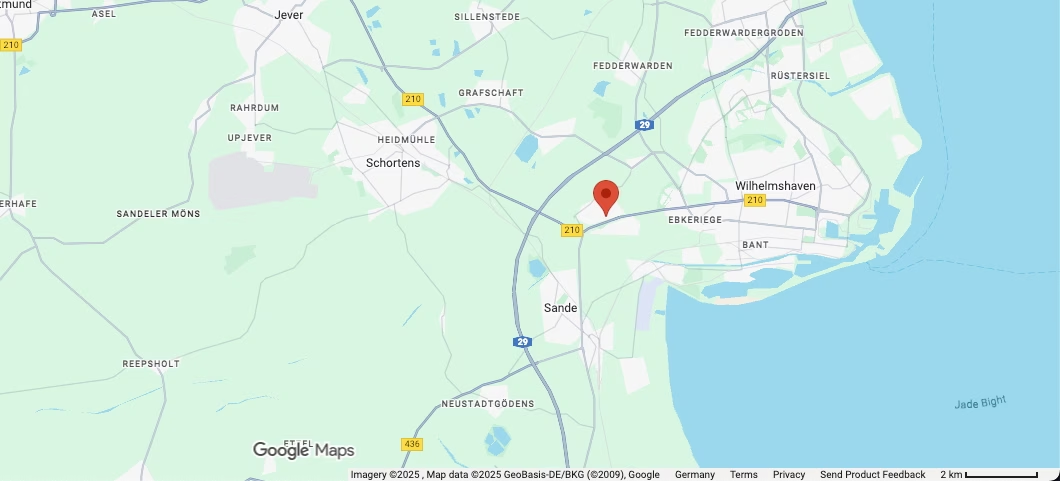
Directions & map
Our headquarters are in Schortens, Lower Saxony. Consulting and demos for customers across Germany are delivered digitally, by phone or on-site by arrangement.
Address: hyperspace GmbH, Olympiastraße 1, Gebäude 12, Eingang 12, D-26419 Schortens-Roffhausen (Niedersachsen)
Economy in Ulm
Your benefits in Ulm
- Science city
- Innovative
- High purchasing power
- Cloud software – available everywhere
- Data in German data centres
- Personal support
- Fast response times
Our services in Ulm
Professional franchise software for businesses in Baden-Württemberg
Frequently asked questions about hyperspace in Ulm
Answers for franchise businesses in Baden-Württemberg
Which industries in Ulm benefit most from hyperspace?
How does hyperspace support quality management for HQs with branches in Baden-Württemberg?
Can we combine store checks and mystery shopping for locations in Ulm?
Where is data hosted—and how does that fit organisations in Ulm?
How fast can we roll out hyperspace for a project in Ulm?
Can we speak with references from industries similar to Ulm?
What makes hyperspace different from spreadsheets or ticketing tools for branch steering?
Does hyperspace offer APIs for existing systems relevant to Ulm?
Discuss your project in Ulm
We will gladly show you how the hyperspace Franchise Manager can advance your business in Ulm.
More locations in Baden-Württemberg
We serve customers across Baden-Württemberg and nationwide.
View all locations